TAPE: Learning General Audio Effect Representations
1Smule, Inc. 2UC San Diego *Equal contribution
1Smule, Inc. 2UC San Diego *Equal contribution
Musicians and mixing engineers often can decipher the signal processing chain they hear on a reference recording, then adapt it to new material. We present TAPE (Transformations of Audio Parameter Embeddings), which estimates this processing from the processed reference audio alone. An encoder trained to identify processors in eight major effect families maps the reference to an embedding. A differentiable digital signal processing (DSP) chain decodes the embedding into editable parameters in one forward pass and applies them to a different unprocessed recording. Its modules are equalization, compression, waveshaping, a small residual network, and reverberation. TAPE achieves lower spectral error than DeepAFx-ST, the previous state of the art for single-step regression, and lower spectral error than per-example search over a chain approximating ST-ITO's, while running 275× faster than that search. Because the decoder outputs DSP parameters, its chain can also run causally: a C++ implementation with the trained weights processed 128-sample buffers 1.8× faster than real time, with no missed deadlines.
TAPE (Transformations of Audio Parameter Embeddings) uses a shared audio encoder that maps a wet reference clip to an embedding z ∈ ℝ256 that does not depend on the source it was heard on. To decode z into human-readable primitives for signal shaping, the inverse g is a factorized differentiable chain of DSP modules for equalization, compression, waveshaping, residual color, and reverberation, each reading its parameters from z through a small head. The entire system is trained end-to-end on content-invariant pairs — the reference and target share the same plugin setting applied to different source recordings — so the only thing z can usefully describe is the treatment, not the content.
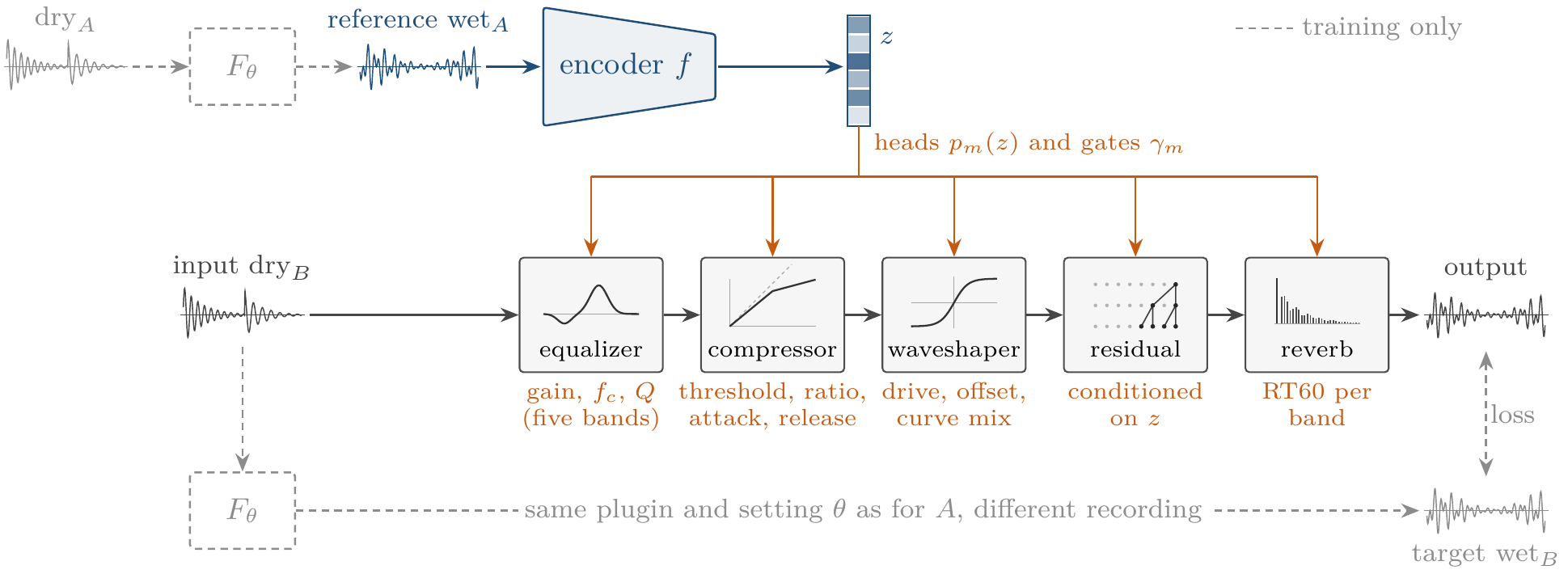
Figure 1. Overview of TAPE. The encoder f maps a processed reference wetA to an embedding z, and small heads map z to the controls and gates of a five-module DSP chain that processes a different recording dryB. In training (dashed), the same plugin configuration θ renders A and B, and the output is compared with wetB. Information about the source of A in z cannot help reconstruct B, but no loss removes it from z.
Each row shows a dry input, the ground-truth reference (real plugin output), and TAPE's predictions before and after GAN fine-tuning. The system receives only the dry signal and a reference wet clip; it predicts plugin parameters to match the effect.
| Dry (Input) | Reference (Real Plugin) | TAPE Pre-GAN | TAPE Post-GAN |
|---|---|---|---|
| Dry (Input) | Reference (Real Plugin) | TAPE Pre-GAN | TAPE Post-GAN |
|---|---|---|---|
| Dry (Input) | Reference (Real Plugin) | TAPE Pre-GAN | TAPE Post-GAN |
|---|---|---|---|
| Dry (Input) | Reference (Real Plugin) | TAPE Pre-GAN | TAPE Post-GAN |
|---|---|---|---|
| Dry (Input) | Reference (Real Plugin) | TAPE Pre-GAN | TAPE Post-GAN |
|---|---|---|---|
| Dry (Input) | Reference (Real Plugin) | TAPE Pre-GAN | TAPE Post-GAN |
|---|---|---|---|
| Dry (Input) | Reference (Real Plugin) | TAPE Pre-GAN | TAPE Post-GAN |
|---|---|---|---|
| Dry (Input) | Reference (Real Plugin) | TAPE Pre-GAN | TAPE Post-GAN |
|---|---|---|---|
A frozen sentence encoder is aligned to TAPE's embedding space, so a text description can stand in for a wet reference: the projected embedding z is decoded by the same DSP inverse and applied to the dry clip below. This demonstrates that the space is indexable from outside audio, not a retrieval benchmark.
| Dry |
|---|
| Text Description | Rendered Effect |
|---|---|
| “clean and transparent, no coloration” | |
| “warm analog tape saturation” | |
| “aggressive distortion with scooped mids” | |
| “bright and airy plate reverb” | |
| “heavy compression, punchy and loud” |
We compare three strategies for training the per-module parameter MLPs: training each module separately, joint fine-tuning from separately-trained modules, and training all modules jointly from scratch.
| Dry | Reference | Separate | Joint Finetune | Joint Scratch |
|---|---|---|---|---|
| Dry | Reference | Separate | Joint Finetune | Joint Scratch |
|---|---|---|---|---|
| Dry | Reference | Separate | Joint Finetune | Joint Scratch |
|---|---|---|---|---|
| Dry | Reference | Separate | Joint Finetune | Joint Scratch |
|---|---|---|---|---|
For reverberation, we compare a direct parameter regression approach (Param MLP) against an impulse-response GAN (IR GAN) that generates a full room IR conditioned on the tone embedding.
| Dry | Reference | Param MLP | IR GAN |
|---|---|---|---|
| Dry | Reference | Param MLP | IR GAN |
|---|---|---|---|
| Dry | Reference | Param MLP | IR GAN |
|---|---|---|---|
| Dry | Reference | Param MLP | IR GAN |
|---|---|---|---|
@article{long2026tape,
  title   = {TAPE: Learning General Audio Effect Representations},
  author  = {Long, Phillip and Zang, Yongyi and Yang, Qihui and Benetatos, Christodoulos and Liu, Junfei and Leistikow, Randal and McAuley, Julian and Cook, Perry R.},
  journal = {arXiv preprint arXiv:2610.40759},
  year    = {2026},
}
 Paper